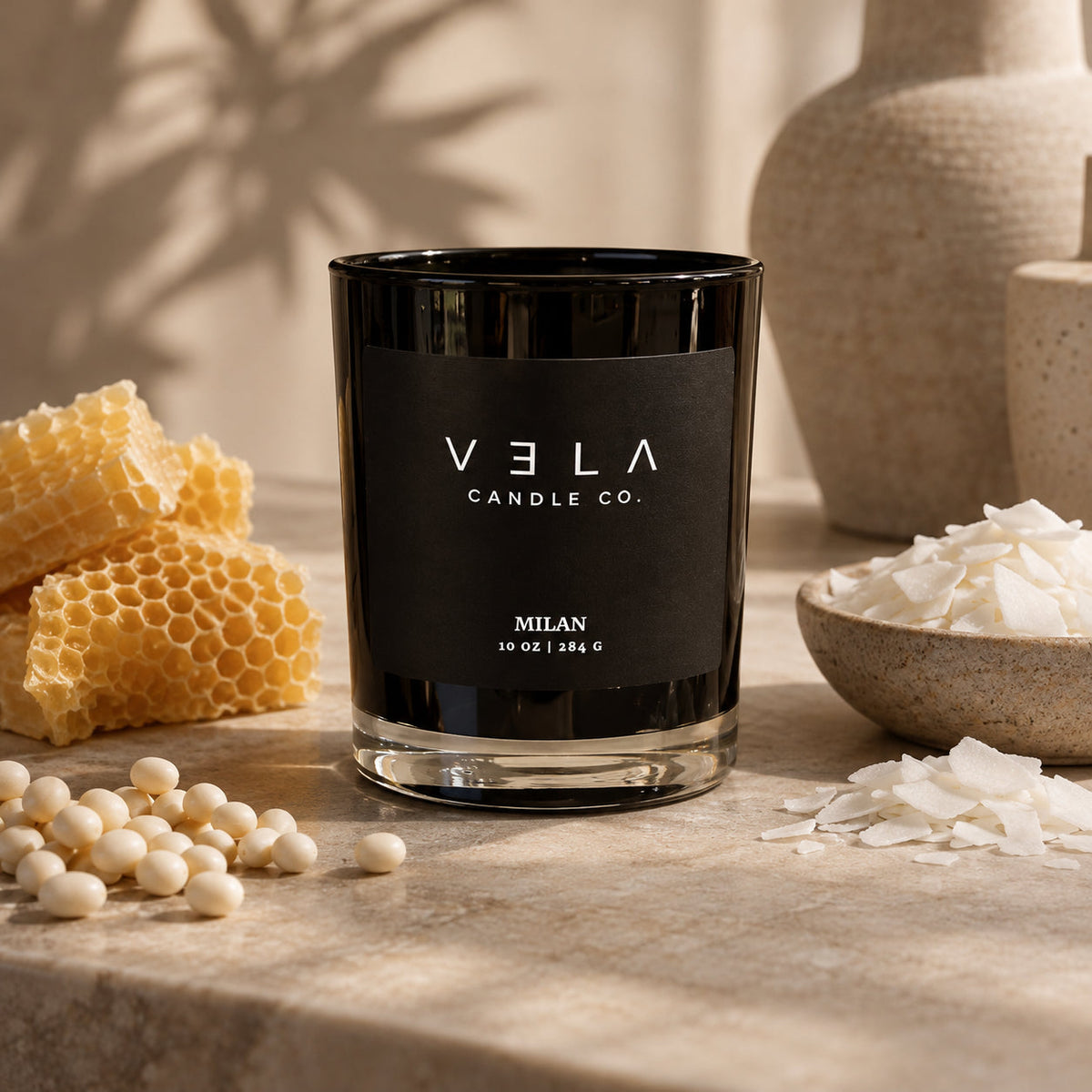
Article: What Are Synthetic Fragrances—and Why Did Vela Choose a Different Path?

What Are Synthetic Fragrances—and Why Did Vela Choose a Different Path?
There’s something almost instinctive about lighting a candle.
We do it to make a room feel warmer. To mark the end of a long day. To welcome friends for dinner. To create a little beauty and calm in the place we call home.
For many of us, candles have become part of the rituals that make everyday life feel just a little more special.
But have you ever stopped to wonder what, exactly, you’re bringing into the room when you light one?
At Vela, that question changed everything.
Like so many people, we loved candles. We loved the atmosphere they created, the warm glow of the flame and the way a beautiful candle could completely change the feeling of a room.
What we didn’t always love was the fragrance.
Some scented candles could be overwhelming. Instead of quietly adding to the atmosphere of a room, the scent became the room. And for people who are particularly sensitive to fragrance, a heavily scented candle can make something that’s supposed to be relaxing feel like anything but.
But our questions went beyond how fragrance smelled.
We also began looking more closely at what fragrance was made from.
What were we actually burning in our homes? What ingredients were creating those powerful scents? And was there a way to make a beautiful, luxurious candle while taking a more thoughtful approach to what went into it?
Those questions helped lead us to Vela.
So, What Is a Synthetic Fragrance?
The word fragrance sounds simple enough. But the scent in a fragranced product may actually be a carefully constructed blend of many aromatic materials.
Some fragrance ingredients come from natural sources. Others are created synthetically to reproduce a scent found in nature, create something entirely new, improve consistency or help a fragrance perform in a particular way.
That’s part of what makes modern fragrance so remarkable.
A candle can smell like vanilla, fresh laundry, a seaside cottage, a forest after the rain or a dessert that just came out of the oven. Fragrance creators can combine aromatic materials to build an experience that may not even exist as a single scent in nature.
There’s a reason synthetic fragrance is so widely used.
People enjoy it.
And we understand why.
But as we learned more, we realized it wasn’t the path we wanted to take with Vela.
Why We Began Looking More Closely at Fragrance
Increasingly, people are paying attention to the ingredients in the products they use every day—from skincare and cleaning products to food packaging and home fragrance.
We were, too.
One area that caught our attention was the growing research surrounding endocrine-disrupting chemicals—substances that can mimic, block or otherwise interfere with the body’s hormones.
One group of chemicals you may have heard mentioned in this conversation is phthalates (pronounced THAL-ates).
In simple terms, phthalates are a family of man-made chemicals used in many everyday products. Some are used to make plastics softer and more flexible, while others have been used in personal-care and fragranced products—for example, to help a fragrance last longer.
Why did that matter to us?
Certain phthalates have been studied for their potential to interfere with the body’s endocrine system—the network of hormones that helps regulate everything from growth and reproduction to metabolism and other important functions.
It’s also important to understand that phthalates are a large family of chemicals, and they don’t all have the same uses or health profiles. The phthalate historically used most commonly in fragrance products is diethyl phthalate, or DEP, which has been used as a solvent and fragrance fixative. The FDA currently reports that it does not have safety concerns about DEP as it is used in cosmetics and fragrances.
So this isn’t as simple as saying “synthetic is bad” or that every fragrance contains ingredients of concern.
The science is much more nuanced than that.
But learning more about fragrance ingredients made us think—and made us want to be more intentional about the ingredients we chose for Vela.
We realized that when something was going to become part of the atmosphere of our homes—something we might light while eating dinner, reading, entertaining friends or settling in at the end of the day—we wanted to be intentional about what we put into it.
For Vela, that meant choosing another direction.
Not because we wanted to frighten people away from fragrance.
Because we wanted to feel really good about our own choices.
When Fragrance Becomes Too Much
There was another part of the equation, too.
Scent is incredibly personal.
A fragrance one person adores may be one another person can’t wait to get away from. Some of us can walk through a perfume department without thinking twice; others find strong fragrances uncomfortable or overwhelming.
Some fragrance-sensitive individuals report physical reactions to fragranced products, and the EPA acknowledges that fragrances may trigger adverse effects in some sensitive people, even though exactly why different people react differently remains an area of scientific discussion.
The same sensitivity can show up when candles are burning in our homes.
And because candles may burn for hours at a time in bedrooms, kitchens, living rooms and other intimate spaces, we began thinking differently about the role scent needed to play.
Did creating a luxurious candle have to mean creating a candle with an intense synthetic fragrance?
We didn’t think so.
In fact, the more we thought about it, the more interested we became in the opposite idea:
What if the luxury came from simplicity?
Choosing Essential Oils—Thoughtfully
For Vela, taking a different path didn’t mean giving up scent altogether.
It meant approaching scent differently.
Vela candles are scented only with essential oils—never synthetic fragrance oils.
Essential oils are concentrated aromatic extracts derived from plants. We loved the idea of creating scent that felt connected to the natural materials and restrained aesthetic at the heart of Vela.
But there is an important distinction here.
We don’t believe that the word natural magically means harmless.
Essential oils are chemically complex materials, too. They contain naturally occurring compounds, and some can cause irritation or other biological effects depending on the oil, concentration and type of exposure. Even naturally derived ingredients deserve thoughtful selection and use.
For us, choosing essential oils isn’t about claiming that everything natural is good and everything synthetic is bad.
It’s about intentional formulation.
Knowing why an ingredient is there.
Using it with purpose.
And making choices that reflect what we want Vela to stand for.
That distinction matters to us.
Discovering the Beauty of Beeswax
Once we stopped thinking of added fragrance as the defining feature of a candle, we could pay much more attention to the candle itself.
And that brought us to beeswax.
Beeswax is a remarkable natural material made by honeybees as they build the honeycomb structures inside their hives. Humans have used it for centuries for many purposes—including candle making.
There is something wonderfully uncomplicated about it.
Natural beeswax has its own subtle character. Depending on how it has been processed and filtered, it can retain a delicate aroma reminiscent of honey and the hive. It has a beautiful warmth and presence that doesn’t need to be hidden beneath an overpowering fragrance.
We loved that.
Instead of asking,
“How much fragrance can we add?”
we found ourselves asking,
“How little do we need?”
That small shift in thinking became a very big part of Vela.
A Different Kind of Candle Experience
We wanted to create a candle for people who love what candlelight does to a room but don’t necessarily want fragrance to dominate it.
A candle you could light during dinner without competing with the aroma of the food.
One you could burn while reading a book or enjoying your morning coffee.
One you could light when friends come over without the fragrance entering the room before they do.
And one that could sit beautifully in your home even when it isn’t burning.
Because a candle is so much more than its scent.
It’s the flicker of the flame reflected in a glass.
It’s the warm light across a dinner table.
It’s the ritual of striking a match at the end of the day.
It’s the feeling that comes from turning off the overhead lights and letting the room soften.
Those things don’t require an overpowering fragrance.
Sometimes candlelight itself is enough.
Why “More” Doesn’t Always Mean “Better”
We’re surrounded by products designed to give us more.
More fragrance. More ingredients. More features. More choices.
But luxury doesn’t always have to mean more.
Sometimes luxury is found in restraint—in choosing beautiful materials and allowing them to do what they naturally do.
That’s an idea we return to often at Vela.
We don’t want to add something simply because it’s expected. Every element should have a reason for being there.
For us, choosing not to build Vela around synthetic fragrance wasn’t about taking something away.
It was about making room for something else.
The natural character of beeswax.
A thoughtfully chosen touch of scent.
The glow of the flame.
The design of the vessel.
And the simple pleasure of candlelight.
What We Bring Into Our Homes Matters
Our homes are personal.
They’re where we sleep, eat, gather, celebrate, recover from long days and spend time with the people we love.
So it makes sense that many of us have started asking more questions about the things we bring into them.
What is this made from?
Why is this ingredient here?
Do I need it?
Is there another way?
We believe candles deserve that same thoughtfulness.
That doesn’t mean there is one perfect candle for everyone. Some people adore heavily fragranced candles and always will.
We aren’t here to tell them they’re wrong.
Vela simply offers another choice.
For someone who loves candlelight but has never loved overpowering fragrance.
For someone who appreciates natural materials.
For someone who reads labels and asks questions.
For someone drawn to simplicity.
And for someone who believes that a beautiful object can be luxurious without being excessive.
The Vela Philosophy
Vela was created around a simple idea:
What we bring into our homes matters.
That belief influences the wax we choose, the way we approach fragrance, the materials we use, the way we design our candles and the questions we continue to ask.
Is it necessary?
Is it beautiful?
Does it serve a purpose?
Can we do it more thoughtfully?
We believe a candle can be beautiful without being overpowering.
It can feel luxurious without being complicated.
It can create atmosphere through the warmth of its flame, the beauty of its design, the subtlety of its scent and the quiet character of natural beeswax.
And perhaps most importantly, it can give people another option.
That’s the path we chose for Vela.
Not because everyone needs to give up the candles they already love.
But because we wanted to make the candle we had been looking for ourselves.
A more thoughtful one.
A more natural one.
A simpler one.
And, we think, a beautiful one.
Welcome to The Vela Journal.
This is where we’ll share more about the materials we choose, the questions we ask, the things we’re learning and our belief that some of life’s most beautiful luxuries can also be the simplest.